CLI Reference
orq-arena is the command-line tool for everything in this project: running the
benchmark, replaying it, re-judging it, and turning a recorded run into reports and
human-annotation pages.
It has seven subcommands: run, pool,
rejudge (including its --compare mode), report,
annotate, anchor, and refresh-catalog.
--version and --help work at the top level; every other flag below belongs to a
specific subcommand.
Usage: orq-arena [OPTIONS] COMMAND [ARGS]...

  orq-arena, LLM arena benchmark: orq.ai router + evaluatorq jury.

Options:
  --version  Show the version and exit.
  --help     Show this message and exit.

Commands:
  anchor           Merge human vote files against a recorded run: κ +...
  annotate         Render a blinded human-annotation page from a recorded...
  pool             Print the configured candidate pool.
  refresh-catalog  Re-fetch the chat model catalog from orq.ai (public; a...
  rejudge          Re-judge a recorded run with a different panel, zero...
  report           Render the single-file HTML report page from a...
  run              Run the arena benchmark (hits orq.ai): headless logs...

  Docs: https://github.com/orq-ai/orq-arena/tree/master/docs · Issues:
  https://github.com/orq-ai/orq-arena/issues
For installation and your first run, see getting-started.md. For the
full orq_arena.yaml key reference, see configuration.md.
At a glance
| Command | Purpose |
|---|---|
run |
Round-robin benchmark via the orq.ai router: headless by default, HTML report written next to the log (--open to view), --tui for the live show. |
pool |
Print the configured candidate pool (seed, name, model id). |
rejudge |
Re-score a recorded battles.jsonl with a different judge panel, zero regeneration; or, with --compare, tabulate saved rejudge reports side by side. |
report |
Render the single-file HTML report page from a recorded run; no model calls, one optional catalog read for prices. |
annotate |
Render a blinded human-annotation page from a recorded run; no API calls. |
anchor |
Merge human vote files back against a run: panel↔human κ + rank correlation; no API calls. |
refresh-catalog |
Force re-fetch of the 24h model-catalog cache. |
Shared behaviors
A few things apply across every subcommand and are only documented once, here:
.envloading: every invocation reads./.envfrom the current directory before doing anything else. A variable already set in your shell always wins over.env.ORQ_API_KEYis the only variable you have to set;ORQ_BASE_URLis read too, to point a run at a non-production orq.ai host. Details (quoting, comments, missing-file handling): configuration.md.- Config validation is all-or-nothing: the entire
--configfile is validated (≥2candidates, non-emptyjudges, thinking-budget cross-checks, etc.) regardless of which fields a given subcommand actually uses. An invalid config file fails the same way forpoolorrefresh-catalogas it does forrun, see Required vs Optional Settings. Unknown keys are part of that validation: a misspelled setting is rejected with a did-you-mean suggestion rather than silently ignored. - Default paths: every default path in the tables below is one of these four, all relative to the current working directory:
| Value | Used by |
|---|---|
orq_arena.yaml |
--config default on rejudge, report, and refresh-catalog; run and pool require an explicit --config (annotate and anchor take no config) |
prompts/starter.jsonl |
run --prompts |
battles.jsonl |
run --output, and the LOG_PATH positional on rejudge and report |
annotate.html |
annotate --output |
--version:orq-arena --versionprints the installed package version.- Stream contract: results go to stdout; messaging (preflight narration, warnings,
progress) goes to stderr. Piping stdout to
grep,jq, or a file never captures progress noise. - Which commands need
ORQ_API_KEY:
| Command | Needs a live API key? |
|---|---|
run |
Yes, model streams, judge calls, and (if enabled) the thinking probe all call the gateway. A key that is set but rejected is caught by the preflight probe before any spend. |
pool |
No, prints the parsed config only. |
rejudge |
Yes, re-scores recorded responses with a live judge panel. |
report |
No. The catalog read that prices the cost section is public, so the cost section renders with or without a key. |
refresh-catalog |
No. The model catalog is public. A key only narrows the list to the models your workspace has enabled. |
annotate / anchor |
No, both work entirely from the recorded log and vote files. |
run
Run the benchmark (a full round-robin over the pool), hits orq.ai. The model pool
comes from the YAML you point --config at, as-is. The run is
headless: matches in parallel, plain log lines on pipes, a progress bar on
terminals, and the HTML report is written next to the battle log at the end
(--open to view it in your browser). --tui runs
the same tournament as the live show instead; it needs the optional [tui]
extra and prints a friendly install hint without it.
The headless run needs no extra.
orq-arena run --config PATH [--prompts PATH] [--output PATH] [--rounds N]
              [--overwrite] [--tui] [--open] [--yes|-y] [--quiet|-q]
| Flag | Default | Effect |
|---|---|---|
--config PATH |
(required) | YAML config: candidates (the model pool), judges, match, gateway; used exactly as written. |
--prompts PATH |
prompts/starter.jsonl |
JSONL prompt file, see Prompts file format, or orq:<dataset_id> to pull an orq.ai Dataset: each datapoint's last user message becomes a prompt, {{var}} placeholders filled from its inputs; datapoints without a user message are skipped. Uses the same API key as the gateway. When the prompts come from a Dataset, the run manifest records its id, display name, and studio URL, and the HTML report links the dataset by name. |
--output PATH |
battles.jsonl |
Where the battle log (schema v4) is written, one line per round as it resolves, so a run killed midway keeps every round it paid for. |
--rounds N |
match.max_rounds from the YAML |
Rounds per match. The preflight warns when this samples a subset of your prompts. |
--overwrite |
off | Allow replacing an existing non-empty battle log at --output; without it the run refuses rather than erase a recorded run. |
--tui |
off | Watch the live TUI show instead of headless logs. Headless runs use headless_concurrency (default 4, see configuration.md) to parallelize matches. |
--open |
off | Open the HTML report in a browser when the run ends (ignored on non-TTY stdout or when CI is set). |
--yes, -y |
off | Skip the preflight confirmation pause. Required when stdin is not a terminal (pipes, CI): without it the run fails fast instead of hanging on a prompt nobody can answer. |
--quiet, -q |
off | Suppress preflight narration and progress; warnings and the final results stay. |
How a run behaves
The model pool is the YAML's candidates list, verbatim. Preflight and the confirmation
prompt happen up front in the terminal, before the TUI (or headless run) even starts. To
discover which model ids your workspace can fight, see
refresh-catalog (--show lists them grouped by provider).
Preflight: call counts. The first line is exact arithmetic, not an estimate:
preflight: {matches} matches × {rounds_per_match} rounds → {model_streams} model streams + {judge_calls} judge calls[ + {probe_calls} probe calls]
Every pair of candidates plays one match, each match runs min(--rounds, number of prompts)
rounds, every round streams both contestants once and is scored by each judge twice (once
per seat order).
Preflight: the RUN PLAN table (see the expected output below). One row per candidate and
judge (call count, catalog price in $/M in / $/M out, cost), closing with a bold
PROJECTED SPEND ≈ $X row and a dimmer worst-case row beneath it.
- Two figures, because one cannot answer both questions honestly. The projection prices
the calls a clean run makes, assuming every response hits its output token cap. The worst
case adds the failure paths that spend money without appearing in any call count: the one
retry each stream takes, and a replacement panel for every judge call when
replacement_judgesis set. - Neither is a hard guarantee. Prices are real (the router's Model Garden catalog) and call counts are exact, but prompt tokens are estimated from character count, which under-counts CJK, code and dense punctuation. Treat the projection as a good estimate, not a cap your invoice cannot exceed.
- Unpriced models (normal for self-hosted) keep their row with
n/aprices and a?cost; the total renders≈ $X + ?with ano catalog price (self-hosted or unpriced): …note below. If pricing is entirely unreachable the table is skipped. Pricing never blocks the run. --quietsuppresses the table but a one-lineprojected spend ≈ $X, up to $Y if streams retry and stand-in judges step instill prints, cost survives quiet mode.- Both figures and the per-row breakdown land in the run manifest under
preflight.cost_projection.
Preflight: the thinking probe (preflight.thinking_probe, default true). A
thinking probe… line, then one line per candidate that failed
(⚠ {name} ({model}): probe failed, {error}) or thinks despite being configured off
(🧠 {name} ({model}): thinks despite config …, ranking will be footnoted). No surprises →
pool is thinking-clean ✓.
Confirmation. Unless --yes/-y is given, the CLI prompts
Proceed (≈ $X, up to $Y with retries)?, so both dollar figures sit in the approval question
itself (plain Proceed? when nothing could be priced). Declining aborts before any battle or judge calls (the thinking probe, when
enabled, has already made its one probe stream per model). When stdin is not an interactive
terminal the run errors out with a "pass --yes" hint instead of prompting.
Streams. Preflight narration, warnings, per-match lines, and the progress bar print to
stderr; the Final Results, token totals, battle-log path, and report-page path print to
stdout. 1>results.txt captures only the results; 2>/dev/null silences the chatter.
Output. Every judged round is appended to --output (battles.jsonl, schema v4) as the
run proceeds, live-run or headless alike.
Examples:
# Fight the shipped pool, confirm the preflight interactively
orq-arena run --config orq_arena.yaml

# Same, skipping the confirmation prompt
orq-arena run --config orq_arena.yaml --yes

# CI/cron -- headless is the default; matches run in parallel (headless_concurrency)
orq-arena run --config orq_arena.yaml --yes

# Custom prompt set and output path, with an alternate pool
orq-arena run --config configs/reasoning_arena.yaml --prompts prompts/starter.jsonl --output reasoning_battles.jsonl
Expected output (headless, piped, both streams shown interleaved; everything above
Final Results is stderr). The preflight and the closing summary are regenerated by running
the tool against the committed
examples/quickstart run,
its 8-model pool against the default judge trio; only the per-round chatter in the middle is
elided, since replaying it would mean re-running the matches:
$ orq-arena run --config examples/quickstart/config.yaml -y \
    --output examples/quickstart/battles.jsonl
  ⚠ each match samples 5 of your 30 prompts (a seeded random slice per match). Pass --rounds 30 to use every prompt each match, or raise match.max_rounds in the YAML.
preflight: 28 matches × 5 rounds → 280 model streams + 840 judge calls + 8 probe calls
  ⚖ judge/contestant family overlap: anthropic/claude-haiku-4-5-20251001, google/gemini-2.5-flash-lite, openai/gpt-5.4-nano. Self-preference bias is not corrected by seat swapping; prefer judges from families outside the pool.
                                   RUN PLAN
┏━━━━━━━━━━━━━━━━━━━━━━━━━━━━━━━━━━━━━━━┳━━━━━━━┳━━━━━━━━┳━━━━━━━━━┳━━━━━━━━━━┓
┃ Model                                 ┃ Calls ┃ $/M in ┃ $/M out ┃     Cost ┃
┡━━━━━━━━━━━━━━━━━━━━━━━━━━━━━━━━━━━━━━━╇━━━━━━━╇━━━━━━━━╇━━━━━━━━━╇━━━━━━━━━━┩
│ Candidates                            │       │        │         │          │
│   anthropic/claude-opus-4-8           │    35 │   5.00 │   25.00 │    $1.80 │
│   anthropic/claude-sonnet-4-6         │    35 │   3.00 │   15.00 │    $1.08 │
│   openai/gpt-5.4                      │    35 │   2.50 │   15.00 │    $1.08 │
│   openai/gpt-5.4-mini                 │    35 │   0.75 │    4.50 │    $0.32 │
│   google/gemini-3.1-pro-preview       │    35 │   2.00 │   12.00 │    $0.86 │
│   google/gemini-3.5-flash             │    35 │   1.50 │    9.00 │    $0.65 │
│   deepseek/deepseek-chat              │    35 │   0.14 │    0.28 │    $0.02 │
│   mistral/mistral-medium-2604         │    35 │   1.50 │    7.50 │    $0.54 │
│ Judges (×2 seat orders)               │       │        │         │          │
│   anthropic/claude-haiku-4-5-20251001 │   280 │   1.00 │    5.00 │    $4.11 │
│   google/gemini-2.5-flash-lite        │   280 │   0.10 │    0.40 │    $0.35 │
│   openai/gpt-5.4-nano                 │   280 │   0.20 │    1.25 │    $0.97 │
│ Thinking probe                        │     8 │        │         │    $0.09 │
├───────────────────────────────────────┼───────┼────────┼─────────┼──────────┤
│ PROJECTED SPEND                       │       │        │         │ ≈ $11.87 │
│ worst case, retries + stand-ins       │       │        │         │ ≈ $36.70 │
└───────────────────────────────────────┴───────┴────────┴─────────┴──────────┘
 every response is assumed to hit its token cap, so a typical run costs less;
         prompt tokens are estimated, so neither figure is a hard cap.
                    Exact spend is reported after the run.
thinking probe…
  pool is thinking-clean ✓
M1 round 1: inconclusive
M1 round 1: A
M1 round 2: inconclusive
M1 round 2: B
M1 round 3: A
M1 gpt-5.4-mini beats gemini-3.1-pro-preview
match 1/28 done
M2 round 1: A
… (one line per judged round; A/B are the round's seat labels; an
inconclusive round redraws a prompt, so round numbers can repeat)
M2 gpt-5.4 beats deepseek-chat
match 2/28 done
M3 🤝 draw
match 3/28 done
…
M28 🤝 draw
match 28/28 done

🏆 gemini-3.5-flash leads, but 76 rated rounds cannot separate it from
claude-sonnet-4-6 (ahead in 83% of resamples; the report page has the
tie-breakers)

                     Final Results
┏━━━┳━━━━━━━━━━━━━━━━━━━━━━━━┳━━━━━━┳━━━━━━━━━━━┳━━━━━━┓
┃ # ┃ Model                  ┃ ELO  ┃ 95% CI    ┃ win% ┃
┡━━━╇━━━━━━━━━━━━━━━━━━━━━━━━╇━━━━━━╇━━━━━━━━━━━╇━━━━━━┩
│ 1 │ gemini-3.5-flash       │ 1374 │ 1184–2209 │ 86%  │
│ 2 │ claude-sonnet-4-6      │ 1196 │ 1010–1886 │ 79%  │
│ 3 │ gpt-5.4                │ 1174 │ 1018–1875 │ 76%  │
│ 4 │ claude-opus-4-8        │ 1072 │ 902–1737  │ 61%  │
│ 5 │ deepseek-chat          │ 1016 │ 820–1632  │ 52%  │
│ 6 │ mistral-medium-2604    │ 901  │ 665–1529  │ 40%  │
│ 7 │ gpt-5.4-mini           │ 805  │ 465–1412  │ 27%  │
│ 8 │ gemini-3.1-pro-preview │ 463  │ -3000–632 │ 5%   │
└───┴────────────────────────┴──────┴───────────┴──────┘

jury: 90% mean agreement · longer answer won 80% of decisive rounds (59/74) ·
the report prices that preference out
rounds: 76 rated · 0 voided
tokens, models 8,350 in / 220,700 out · jury 1,481,428 in / 107,697 out

battle log → examples/quickstart/battles.jsonl
report page → examples/quickstart/battles.report.html
Every number here is reproducible from the committed log: the intervals are a seeded
1000-resample bootstrap, so orq-arena report examples/quickstart/battles.jsonl re-derives
the same bounds rather than redrawing them.
On a terminal (not piped) the per-round heartbeat lines are replaced by a pinned
progress bar (spinner, rounds M-of-N, elapsed, current leader) that advances once per
round, with the per-match lines printing above it; without -y the run pauses at
Proceed (≈ $11.87, up to $36.70 with retries)? [y/N] after the preflight, before any battle or
judge call.
See Match rules, gateway, candidates, and judges for every YAML key this command reads, and methodology.md for how matches are scheduled and scored.
The --tui live show
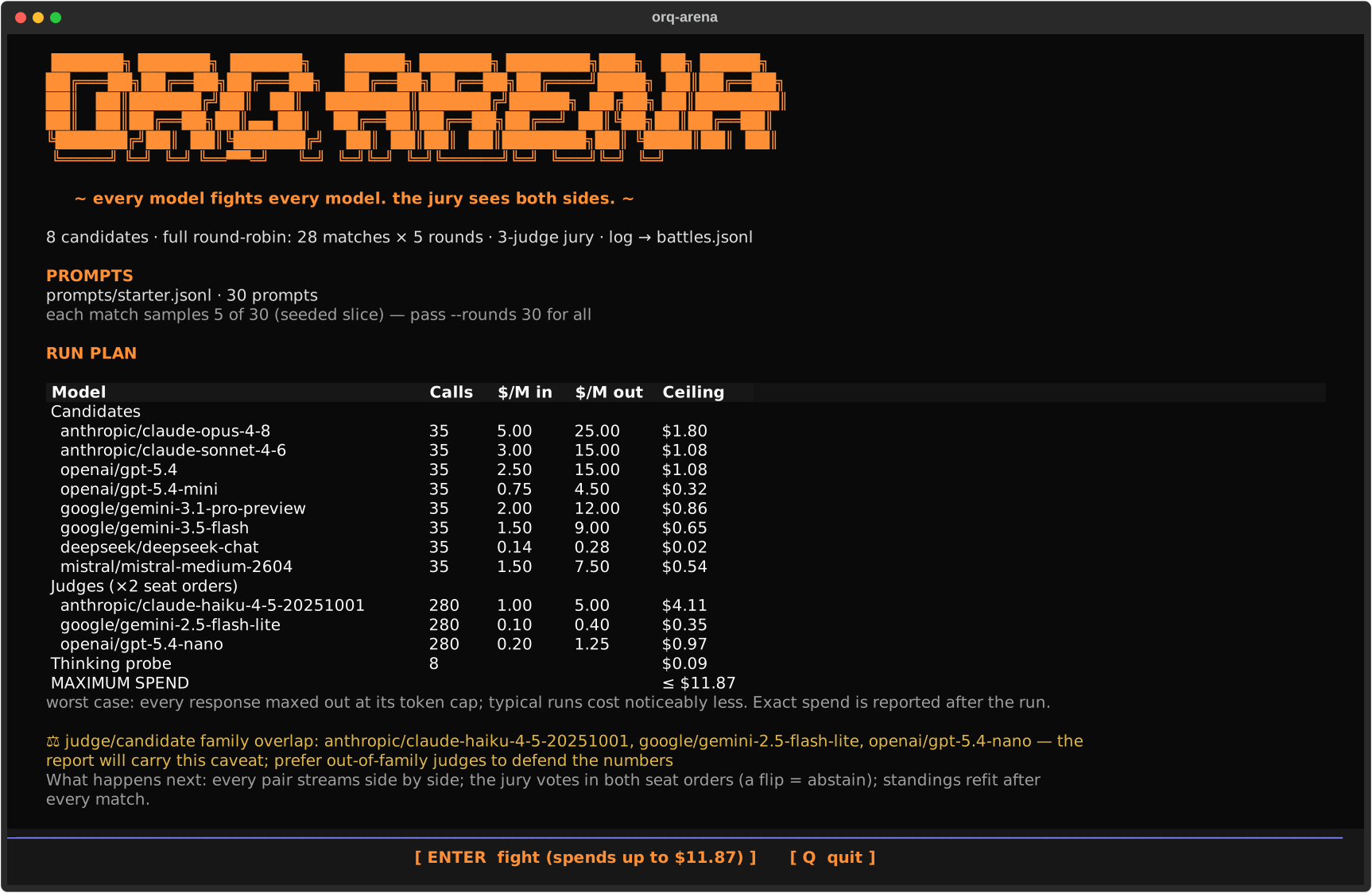
orq-arena run --tui opens on the RUN PLAN screen: the branding, the prompt set and its
size, and the full per-model cost table (every candidate and judge listed, cost per row),
ending in the run's one confirmation,
ENTER fight (≈ $X, up to $Y with retries) / Q quit.
Nothing has been spent when it renders except the tiny thinking-probe calls; -y skips the
screen and starts the fight directly. On endpoints without catalog pricing the table keeps
its call counts and the spend line reads spend projection unavailable.
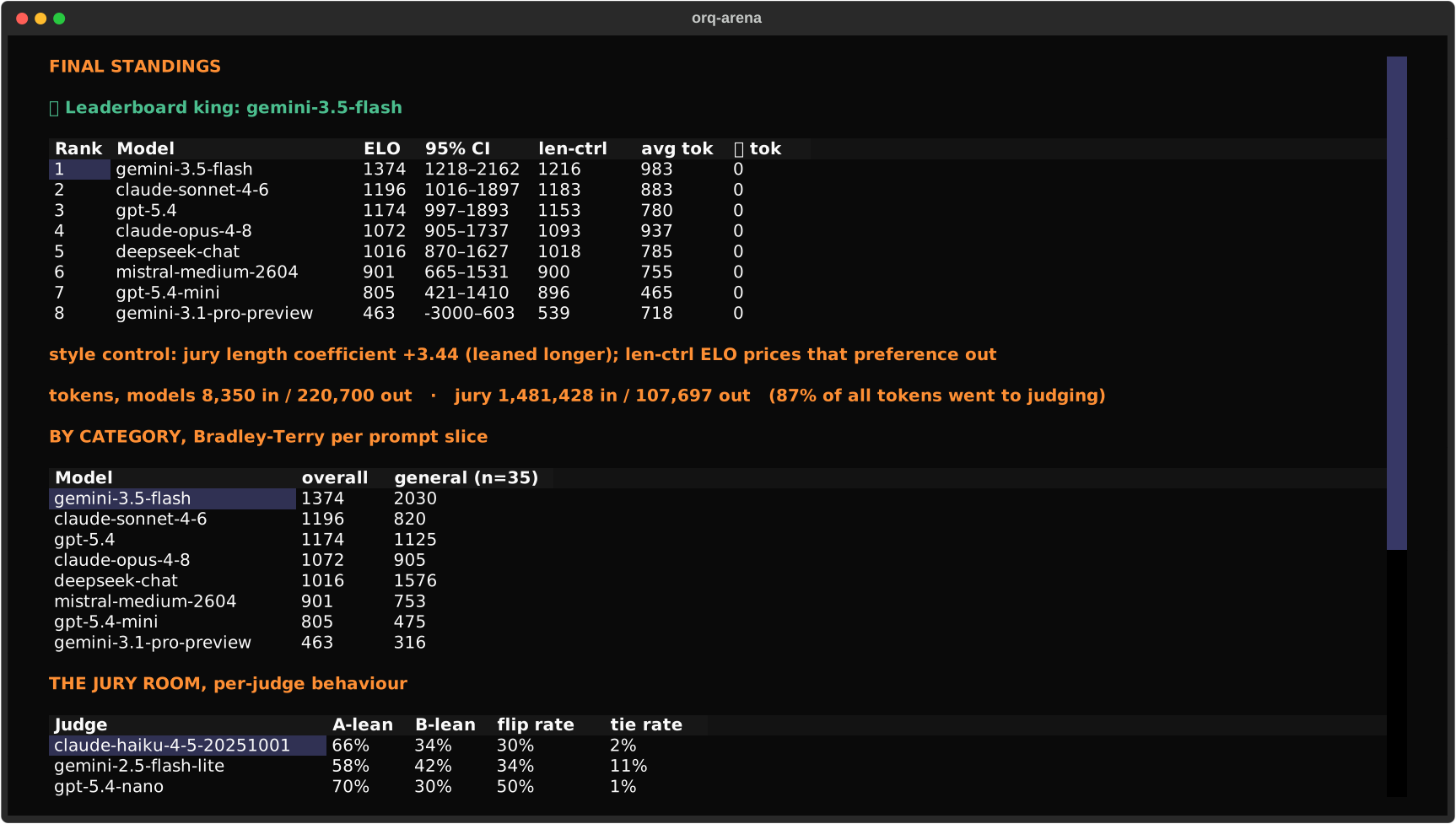
The run ends on the Final Results screen: ELO with its 95% CI and, when the jury's length preference is statistically identified, a len-ctrl rating per model, the per-category slices, per-judge behaviour (A/B lean, flip rate, tie rate, Fleiss' κ), and the win grid.
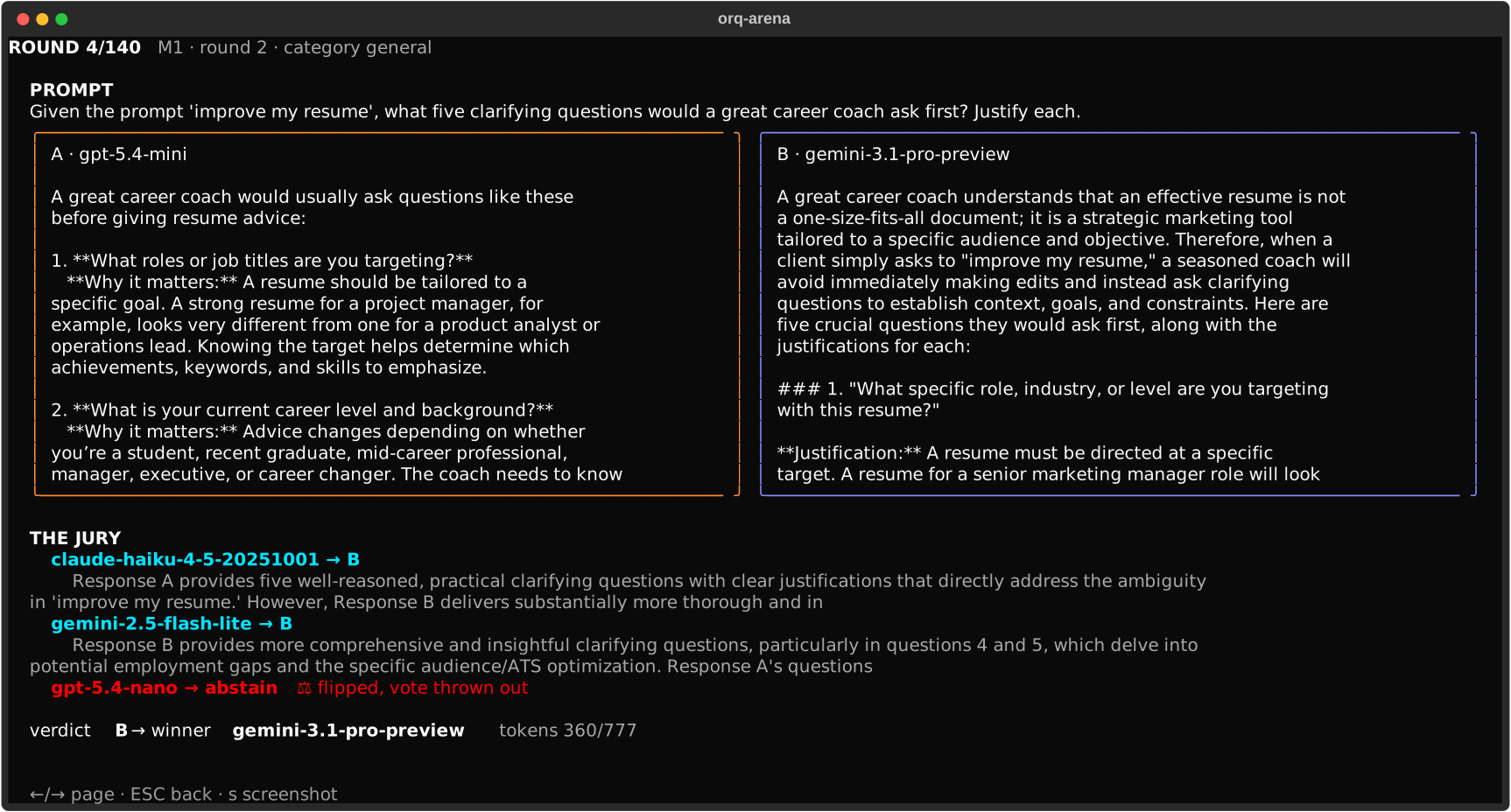
From the final leaderboard: B opens the battle browser, paging through every judged
round with the prompt, both responses, and per-judge votes with flip badges; s saves an
SVG screenshot; q quits.
pool
Print the configured candidate pool, no API calls, no key required.
| Flag | Default | Effect |
|---|---|---|
--config PATH |
(required) | YAML config whose candidates are printed. |
--json |
off | Print the pool as a JSON array of {seed, name, model_id} objects instead of the table. |
Behavior notes:
- Prints a fixed-width table: seed number,
name(falls back to the model's short name, see configuration.md), and the fullmodel_id, in config order, 1-indexed.
Expected output, against the shipped orq_arena.yaml (8 candidates, one with a custom name):
Seed  Name                       Model ID
----------------------------------------------------------------------
1     claude-opus-4-8            anthropic/claude-opus-4-8
2     claude-sonnet-4-6          anthropic/claude-sonnet-4-6
3     gpt-5.4                    openai/gpt-5.4
4     gpt-5.4-mini               openai/gpt-5.4-mini
5     gemini-3.1-pro-preview     google/gemini-3.1-pro-preview
6     gemini-3.5-flash           google/gemini-3.5-flash
7     deepseek-v4-pro            nebius/deepseek-ai/DeepSeek-V4-Pro
8     mistral-medium-2604        mistral/mistral-medium-2604
rejudge
Re-judge a recorded run with a different panel, zero regeneration. The responses in the
battle log are already on disk, so swapping the jury costs judge tokens only. rejudge has two
mutually exclusive modes: the default --judge mode re-scores a log with a new panel, and
--compare tabulates saved rejudge reports side by side (no API calls).
orq-arena rejudge [LOG_PATH] --judge MODEL_ID [--judge MODEL_ID ...] [--criteria TEXT]
                  [--config PATH] [--output PATH] [--report-json PATH] [--concurrency N]
orq-arena rejudge --compare REPORT_JSON [--compare REPORT_JSON ...]
| Argument / Flag | Default | Effect |
|---|---|---|
log_path (positional) |
battles.jsonl |
Recorded battle log to re-judge (schema v4 JSONL; v3 still loads). Optional, omit it to re-judge the default log in the current directory. Ignored in --compare mode. |
--judge MODEL_ID |
none, required unless --compare, repeatable |
Router model id for the new panel; pass --judge multiple times for a multi-judge panel. Mutually exclusive with --compare. |
--compare REPORT_JSON |
none, repeatable | Switches to compare mode: tabulate the given saved rejudge report JSONs side by side (see rejudge --compare). Mutually exclusive with --judge; makes no API calls. |
--criteria TEXT |
criteria from --config |
Override the judging criteria for this rejudge only, doesn't touch the YAML file. |
--config PATH |
orq_arena.yaml |
Supplies gateway, and (unless overridden) criteria, replacement_judges, and min_successful_judges. |
--output PATH |
none, result only printed | Write the re-judged rounds to this JSONL path. |
--report-json PATH |
none, result only printed | Write the run summary as JSON. |
--concurrency N |
4 |
Max concurrent judge calls. |
Behavior notes:
- Which rounds are re-judged. Only complete rounds: rows with both responses present
and no recorded error. Voided or errored rounds are silently skipped. If nothing
qualifies, the command exits with
no judgeable rounds in {log_path}. - Self-judge exclusion. For each contestant pair, any
--judgethat is one of the contestants is dropped from that pair's panel, the same rule live matches apply. Contestants are matched against the pool recorded in the<log>.run.jsonmanifest, the pool the run actually used, never the current YAML, which may have drifted since. Without a manifest the CLI warns and falls back to--config. If exclusion leaves a pair with no judges at all, the command errors withevery judge is a contestant in {pair}; add a neutral model to--judgeto fix it. - Small panels are fine. The YAML's
min_successful_judgesquorum (sized for the original run's, typically larger, panel) is clamped down to the rejudge panel's size, so a legitimate 1- or 2-judge rejudge is never rejected by a quorum meant for a bigger jury. - Report contents:
re-judged {N} rounds, {M} verdicts changed(vs. the recordedmajority_verdict)- Spearman rank correlation between the old and new Bradley-Terry rankings, printed with
the model and round counts behind it (
0.80 over 8 models, 140 rounds, ...). The verdict word needs a pool of at least 5 models to be earned: at 4 the only reachable values at or above the 0.8 bar are 0.8 and 1.0, so smaller pools printtoo few models (N) for a robustness verdictinstead. At 5+ models,>= 0.8readsjudge-robust ranking, below itranking is panel-sensitive; treat with care. old ranking: A > B > C ...andnew ranking: ...strings- a "new jury behaviour" table, one row per judge:
A-lean,B-lean,flip rate(position bias, how often a judge's verdict flips depending on seat order),tie rate mean inter-judge agreement, when the panel has more than one judge--outputwrites one JSONL row per input record withjudge_votes,majority_verdict, andwinnerreplaced by the new panel's verdict; every other field (prompt, both responses, tokens, timings) is copied through unchanged.--report-jsonwrites:
{
  "total": 0,
  "changed_verdicts": 0,
  "spearman": 0.0,
  "old_ranking": ["..."],
  "new_ranking": ["..."],
  "jury": { "...": "full evaluatorq report, including per_judge stats" }
}
Examples:
# Single-judge rejudge of the default log against the default config
orq-arena rejudge battles.jsonl --judge mistral/mistral-small-2603

# Multi-judge panel
orq-arena rejudge battles.jsonl --judge mistral/mistral-small-2603 --judge anthropic/claude-haiku-4-5-20251001

# Override criteria, write both the rejudged log and a JSON summary
orq-arena rejudge battles.jsonl \
  --judge mistral/mistral-small-2603 \
  --criteria "Correctness only; ignore style." \
  --output battles.rejudged.jsonl \
  --report-json rejudge_report.json

# Higher concurrency against a non-default log
orq-arena rejudge my_battles.jsonl --judge openai/gpt-5.4-nano --concurrency 8
Expected output. The command line, the re-judging … line and the round count are real
(the committed example log has 140 judgeable rounds). Everything after that is illustrative:
running it for real costs judge tokens, so the verdict counts, the Spearman value and the
per-judge percentages below are stand-ins showing the shape, not a recorded result.
$ orq-arena rejudge examples/quickstart/battles.jsonl --judge openai/gpt-5.1
re-judging 140 rounds with panel: openai/gpt-5.1

re-judged 140 rounds, 23 verdicts changed
rank correlation (Spearman) old→new: 0.80 over 8 models, 140 rounds, judge-robust ranking
old ranking: gemini-3.5-flash > claude-sonnet-4-6 > gpt-5.4 > claude-opus-4-8 >
deepseek-chat > mistral-medium-2604 > gpt-5.4-mini > gemini-3.1-pro-preview
new ranking: claude-sonnet-4-6 > gemini-3.5-flash > gpt-5.4 > claude-opus-4-8 >
deepseek-chat > mistral-medium-2604 > gpt-5.4-mini > gemini-3.1-pro-preview
       new jury behaviour
┏━━━━━━━━━┳━━━━━━━━┳━━━━━━━━┳━━━━━━━━━━━┳━━━━━━━━━━┓
┃ judge   ┃ A-lean ┃ B-lean ┃ flip rate ┃ tie rate ┃
┡━━━━━━━━━╇━━━━━━━━╇━━━━━━━━╇━━━━━━━━━━━╇━━━━━━━━━━┩
│ gpt-5.1 │ 48%    │ 52%    │ 10%       │ 13%      │
└─────────┴────────┴────────┴───────────┴──────────┘
Below a Spearman of 0.8 the second line ends
ranking is panel-sensitive; treat with care instead, and on a pool of fewer
than 5 models it ends too few models (N) for a robustness verdict, since the
statistic is too coarse there to grade. A mean inter-judge agreement: NN%
line follows the table whenever the panel has more than one judge.
rejudge --compare
Compare candidate juries over the same recorded log, a mode of rejudge selected by
passing --compare instead of --judge. The selection loop: run once, then for each candidate
panel rejudge <log> --judge ... --report-json candidate.json (judge tokens only), then compare
the saved reports with rejudge --compare. Makes no API calls.
--compare is a repeated flag, not a list
Pass --compare once per report: --compare solo.json --compare panel.json.
A bare second path (--compare solo.json panel.json) silently binds to the
LOG_PATH positional instead, and the table tabulates only the first report.
Columns per candidate: Spearman vs the recorded ranking (does the ranking depend on this
jury?), inconclusive rate (decisiveness), mean agreement, worst per-judge flip rate
(self-consistency), tie rate, changed verdicts. These measure reliability, not accuracy;
which jury is right needs gold pairs or a human anchor (see annotate and anchor).
orq-arena rejudge battles.jsonl --judge openai/gpt-5.1 --report-json solo.json
orq-arena rejudge battles.jsonl --judge anthropic/claude-haiku-4-5-20251001 \
  --judge openai/gpt-5.1 --report-json panel.json
orq-arena rejudge --compare solo.json --compare panel.json
Expected output (the compare step itself makes no API calls, but producing the two report
JSONs it reads does, so the numbers below are illustrative in the same way the
rejudge block's are; the columns and labels are exact):
                                  jury candidates over the same recorded log
┏━━━━━━━━━━━━━━━━━┳━━━━━━━━━━━━━━━━━┳━━━━━━━━━━━━━━┳━━━━━━━━━━━┳━━━━━━━━━━━━━━━━━┳━━━━━━━━━━┳━━━━━━━━━━━━━━━━┓
┃ panel           ┃ spearman vs run ┃ inconclusive ┃ agreement ┃ worst flip      ┃ tie rate ┃ changed        ┃
┃                 ┃                 ┃              ┃           ┃ (judge)         ┃          ┃ verdicts       ┃
┡━━━━━━━━━━━━━━━━━╇━━━━━━━━━━━━━━━━━╇━━━━━━━━━━━━━━╇━━━━━━━━━━━╇━━━━━━━━━━━━━━━━━╇━━━━━━━━━━╇━━━━━━━━━━━━━━━━┩
│ gpt-5.1         │ 0.80 over 8     │ 10%          │ n/a       │ 10% (gpt-5.1)   │ 13%      │ 23/140         │
│ claude-haiku-4… │ 1.00 over 8     │ 17%          │ 86%       │ 13% (gpt-5.1)   │ 7%       │ 11/140         │
│ gpt-5.1         │                 │              │           │                 │          │                │
└─────────────────┴─────────────────┴──────────────┴───────────┴─────────────────┴──────────┴────────────────┘
read: high spearman = the ranking does not depend on this jury; low inconclusive = decisive; low flip =
self-consistent. These measure reliability, not accuracy; accuracy needs gold pairs or a human anchor.
report
Render the single-file HTML report page from a recorded run. Reads battles.jsonl and its
*.run.json manifest; makes no model calls (one catalog read prices the cost section when a
key is present). The same page is written automatically at the end
of every run (<log>.report.html next to the log).
The manifest is the source of truth for run identity. Model names, the judge panel and the
reasoning flags come from the manifest the run wrote, not from whatever the YAML says today, so a
page rebuilt months later still describes that run. A manifested log therefore needs no config file
at all. Two cases break that chain, and both are stated on the page itself rather than only on the
console: a log with no readable manifest (identity falls back to --config), and an explicit
--config whose contents don't match the run's recorded config_sha256 (your file wins, by
request).
| Flag / arg | Default | Effect |
|---|---|---|
LOG_PATH (positional) |
battles.jsonl |
The recorded run to render. |
--config PATH |
orq_arena.yaml, only as a fallback |
Overrides the run's recorded identity (judge panel, model-name mapping, reasoning flags) when passed explicitly, and the page discloses that it was overridden. Left alone, it is used only when the log has no usable manifest; match rules are never consulted. |
--output PATH |
<log>.report.html |
Destination HTML file. |
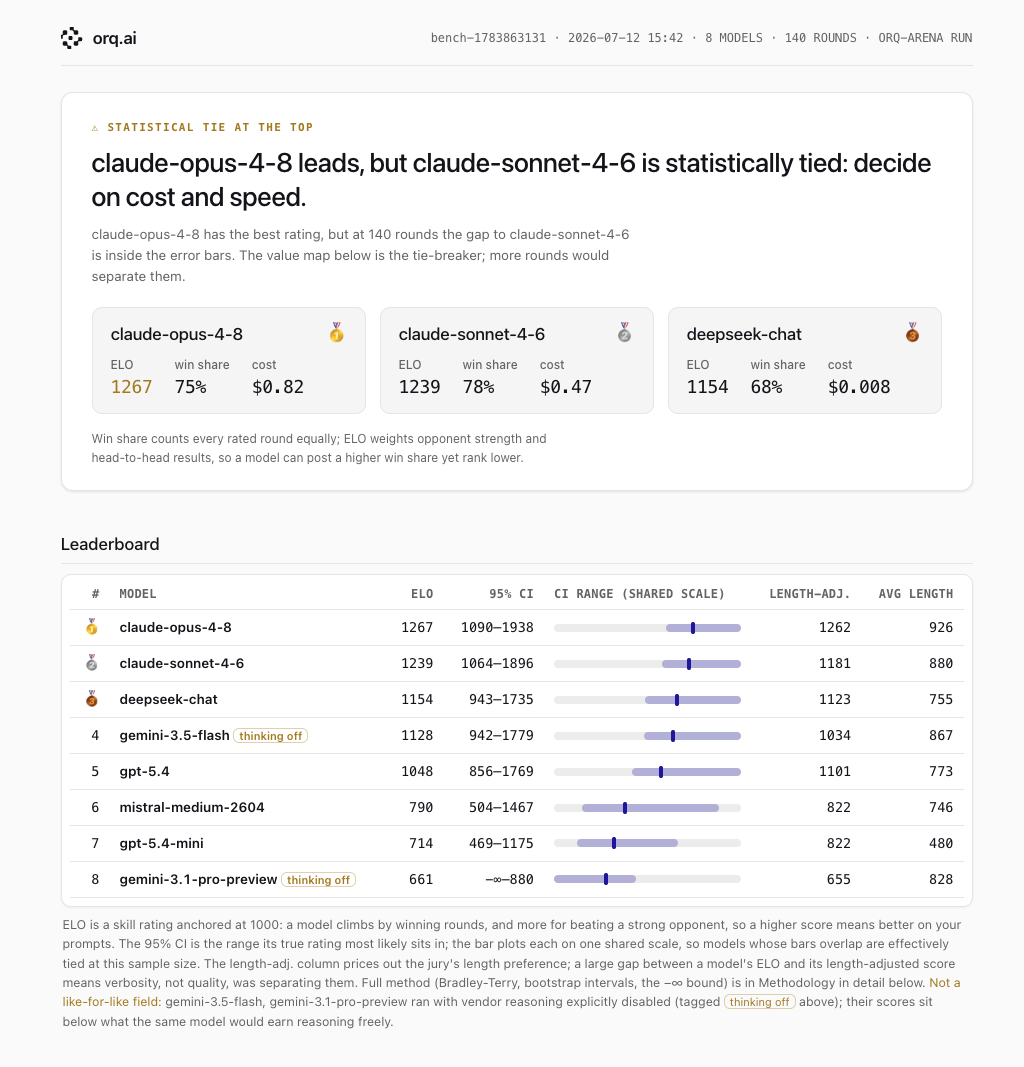
The page is self-contained (inline CSS, no external assets, works from file://): verdict
headline stating whether the top two separate, the ELO ladder with confidence-interval bars and the
length-adj. column, the win grid, per-judge behaviour, token and cost accounting (catalog
rates when a key is present: candidate spend exact, jury spend estimated at the panel mean;
one catalog read, never completion spend), and the
manifest hashes for reproducibility.
Expected output (one line; without a key the page's cost section is simply omitted, nothing warns or fails):
$ orq-arena report examples/quickstart/battles.jsonl
report page -> examples/quickstart/battles.report.html
annotate
Render a blinded human-annotation page from a recorded run. Reads battles.jsonl; makes no
API calls. This is the front half of the human-anchor workflow (the back half is
anchor): the accuracy check that converts "the panel agrees with itself" into
"the panel agrees with people" (see
Methodology → Human anchor).
orq-arena annotate BATTLE_LOG [--output PATH] [--sample N] [--seed N] [--criteria TEXT]
                  [--exclude VOTES_JSON ...] [--serve] [--port N] [--no-open]
| Flag / arg | Default | Effect |
|---|---|---|
BATTLE_LOG (positional) |
required | The recorded run to annotate. |
--output PATH |
annotate.html |
Destination HTML file. |
--sample N |
all rounds | Annotate a seeded random subset instead of every round. |
--criteria TEXT |
the jury's default rubric | Judging guidelines shown to the rater. |
--seed N |
42 |
Drives round order and per-round side flips; keep it if you want two raters on identical pages. |
--exclude PATH |
none | votes.json file(s), repeatable: rounds already voted there are dropped, producing a resume page with only the remaining rounds (or a top-up page when growing a study). |
--serve |
off | Prodigy-style local mode: serve the page at http://127.0.0.1:<port> (and open it) instead of writing a file. Every vote saves automatically as votes-<annotator>.json next to the log (no download step); Ctrl-C stops the server and prints the anchor table for whatever was voted. Localhost-only by construction; for remote raters use the default file mode. |
--port N |
8765 |
Port for --serve; 0 picks a free one. |
--no-open |
off | Don't open the written page in a browser. File mode only: it writes the file and stops. (Without it the page opens on a TTY, unless CI is set. --serve opens its URL regardless of this flag.) |
The page is one self-contained HTML file (inline CSS/JS, no external assets, works from
file://), so "deployment" is sending someone the file. It is blind by construction:
model names, jury votes, and verdicts never enter the payload; rounds are shuffled and the
two responses swap sides per round under the seed; round keys are one-way hashes.
The rater's flow has three views. An intro states what the task is, the round count, a
rough time estimate, the criteria to weigh (--criteria, defaulting to the jury's default
rubric), the key legend, and asks for their name. The annotation view shows one prompt
and two anonymous responses; votes go by a (left better), b (right better), t (tie),
space (skip), arrows to navigate; markdown and code fences render properly. After the last
round a done screen shows how many rounds were voted vs skipped and holds the explicit
"Download votes.json" button (plus a leave-warning while votes are undownloaded; left arrow
goes back to revisit skips). A persistent header count (voted / skipped / left) and a
clickable per-round dot navigator (voted, tie, skipped, unseen, current) keep position
visible at all times; n jumps to the next unvoted round. Exported votes are already
un-flipped to the canonical A/B frame, so the vote file is independent of presentation
order.
orq-arena annotate outputs/g1/battles.jsonl --sample 60
orq-arena annotate battles.jsonl --output rater2.html --seed 42
# resume: only the rounds dana hasn't voted yet
orq-arena annotate battles.jsonl --exclude votes-dana.json --output dana-round2.html
# annotate your own run locally, votes save as you click, Ctrl-C prints the numbers
orq-arena annotate outputs/g1/battles.jsonl --serve --sample 60
Expected output (file mode; --serve prints the local URL instead and holds until Ctrl-C):
$ orq-arena annotate examples/quickstart/battles.jsonl --output annotate.html --sample 10
10 rounds -> annotate.html (blind; votes export as votes.json)
anchor
Merge one or more human vote files back against the recorded run and print the human-anchor numbers; no API calls.
| Flag / arg | Default | Effect |
|---|---|---|
BATTLE_LOG (positional) |
required | The same log the annotation page was generated from. |
VOTES_JSON (positional, repeatable) |
required | Vote files exported by the annotation page, one per rater. |
--json |
off | Print the same stats as one JSON object (per_annotator, inter_annotator, panel_ranking, unknown_keys) instead of the table; undefined Spearman values become null. |
Output, per annotator: rounds voted, rounds usable for κ (the panel must have been decisive;
inconclusive rounds are excluded from κ but still feed the human Bradley-Terry fit), Cohen's
κ vs the panel majority with its Landis-Koch label, and the Spearman correlation between the
human-vote Bradley-Terry ranking and the panel's, both fit on the rounds that rater
actually voted: the panel side is refit on the same subset, a model with fewer than 3
co-voted comparisons earns no place in either ranking (it would sit at the 1000 default and
the correlation would partly measure that filler), and the ρ models column carries the n so
a correlation over 4 models cannot read like one over 40. With two or more vote files it also
prints each rater pair's inter-annotator κ over their shared rounds. Votes whose key matches
no round in the log are counted and warned, never crash.
Expected output. Illustrative: the columns, labels and Landis-Koch words are exact, but the
numbers are stand-ins. Real ones need real raters, and no vote files ship with this repo, so
there is nothing committed here to reproduce them from. To get your own, run
annotate on a log, have two people vote, and point anchor at the two
votes-*.json files.
                             human anchor vs panel
┏━━━━━━━━━━━┳━━━━━━━┳━━━━━━━━━━┳━━━━━━━━━━━━┳━━━━━━━━━━━━━━━━┳━━━━━━━━┳━━━━━━━━━━┓
┃ annotator ┃ voted ┃ κ rounds ┃ κ vs panel ┃ label          ┃ rank ρ ┃ ρ models ┃
┡━━━━━━━━━━━╇━━━━━━━╇━━━━━━━━━━╇━━━━━━━━━━━━╇━━━━━━━━━━━━━━━━╇━━━━━━━━╇━━━━━━━━━━┩
│ h1        │ 29    │ 19       │ 0.90       │ almost perfect │ 0.80   │ 6        │
│ h2        │ 27    │ 19       │ 0.80       │ substantial    │ 0.80   │ 6        │
└───────────┴───────┴──────────┴────────────┴────────────────┴────────┴──────────┘
inter-annotator h1 × h2: κ=0.44 (moderate, 26 rounds)
refresh-catalog
Re-fetch the chat model catalog from orq.ai, bypassing the cache. The catalog is public; a key narrows the list to the models your workspace has enabled.
| Flag | Default | Effect |
|---|---|---|
--config PATH |
orq_arena.yaml |
Only gateway is used (base URL, API key env var name). |
--show / --no-show |
--no-show (off) |
Print every fetched model id, grouped by provider. |
Behavior notes:
- Bypasses the 24h cache at
~/.cache/orq-arena/models.jsonand re-fetches the catalog live from orq.ai. Non-chat models (embeddings, TTS/STT, image, rerank, moderation, etc.) are excluded because the catalog states each model'sendpoints, not because their ids look a certain way; deprecated models are excluded too. Use--showto discover model ids for your YAML'scandidateslist; the same catalog also prices the preflight spend projection and the report's cost section. - Without
ORQ_API_KEY: the catalog is public, so the fetch still happens and you get the full chat-capable list. A key adds one thing: the list is narrowed to the models your workspace has enabled. If that narrowing call fails or returns nothing, the full catalog stands rather than showing you nothing. - Only a successful live fetch overwrites the cache file; if the fetch fails, the existing cache (if any) is left untouched and simply re-reported.
- Always prints one summary line (to stderr, per the stream contract;
--show's model list is the stdout payload):{count} models (source={live|cache|stale|fallback}, age={seconds}s, cache={path}).sourceis what the fetch did, andageis how old the rows are:livecame off the network just now,cacheis a copy still inside its 24h window,stalemeans the fetch failed and the cache was served anyway, andfallbackmeans there was nothing to serve. A failed refresh reads asstale, never aslive, which is the whole point of asking. --showadditionally prints every model id grouped by provider (providers and ids both sorted). Which providers and how many ids you see is whatever your workspace has enabled, so treat the shape below as the example, not the counts:
anthropic  (6)
  anthropic/claude-haiku-4-5-20251001
  anthropic/claude-opus-4-8
  ...

openai  (9)
  openai/gpt-5.4
  openai/gpt-5.4-mini
  ...
Examples:
orq-arena refresh-catalog
orq-arena refresh-catalog --show
orq-arena refresh-catalog --config configs/reasoning_arena.yaml --show
Expected output (here keyless: the catalog is public, so the fetch still happens and the
full chat-capable list comes back. With a key the count is whatever your workspace has
enabled, and source is stale instead of live if the fetch failed and a cache was
served):
$ orq-arena refresh-catalog
483 models (source=live, age=2s, cache=/Users/you/.cache/orq-arena/models.json)
Common workflows
See it work with zero setup
No key yet? Open the committed example run's report,
examples/quickstart/battles.report.html,
or regenerate it keyless from the committed log:
Then get a key: https://docs.orq.ai/docs/ai-studio/organization/api-keys.
First live run
Fights the shipped orq_arena.yaml pool headless; edit its candidates list to change the
pool. Confirm the preflight to spend tokens.
Run for CI/cron
--yes skips the confirmation prompt, safe for a non-interactive shell; plain line-per-match
output on pipes.
Compare two juries on the same recorded run
orq-arena rejudge battles.jsonl --judge mistral/mistral-small-2603 --judge anthropic/claude-haiku-4-5-20251001
Costs judge tokens only, the responses already in battles.jsonl are reused as-is. Prints
the changed-verdict count and the Spearman rank correlation against the original ranking.
Discover model ids for your model pool
Forces a live re-fetch (bypassing the 24h cache) and lists every chat-capable model id,
grouped by provider, ready to paste into your YAML's candidates list. With a key set, the
list is narrowed to the models your workspace has enabled.
Scripting & CI
Everything you need to run orq-arena unattended or pipe its output:
- Confirmation:
runrequires--yes/-ywhen stdin is not a terminal; without it the command fails immediately with that hint instead of hanging on a prompt. - Streams: results on stdout, messaging (preflight narration, warnings, progress) on
stderr.
orq-arena run --config orq_arena.yaml -y 1>results.txt 2>run.logseparates them cleanly. - Quiet:
run --quiet/-qdrops narration and progress; warnings and the final standings still print. - No animations off-TTY: when stderr is not a terminal the progress bar is replaced by
plain line-per-match output, so CI logs stay readable. The HTML report never auto-opens
off-TTY or when
CIis set. - Machine-readable output:
pool --jsonandanchor --jsonprint JSON to stdout;rejudge --report-json <file>writes its summary as JSON. - Color: output honors the standard
NO_COLORandFORCE_COLORenvironment variables and disables color on non-TTY streams automatically. - Exit codes:
0success,1any runtime error (printed asError: …on stderr),2usage error (unknown flag, bad value).
See also
| Doc | What it covers |
|---|---|
| Getting Started | Prerequisites, install, first live run, common setup issues |
| Configuration Reference | Every orq_arena.yaml key, .env loading, reasoning recipes, defaults |
| Methodology | How the ranking is made, bias controls, confidence intervals, reproducibility |
| README | Project overview, installation, quick start |