Getting Started
This guide takes you from a fresh clone to your first benchmark: a round-robin tournament over your model pool, judged in both seat orders by an evaluatorq pairwise jury, ranked by Bradley-Terry ELO with confidence intervals attached.
The path is five steps:
- Install the CLI (
uv tool install). - Add your orq.ai API key (
.env). - Run the benchmark and read the standings.
- Bring your own prompts: a local JSONL file or an orq.ai Dataset.
- Know where the results land: the battle log, the manifest, and the HTML report.
Every command below runs through the orq-arena CLI. Run orq-arena --help to
list every subcommand; the full flag reference is in cli.md.
Prerequisites
| Requirement | Minimum | How to check |
|---|---|---|
| Python | >= 3.10 |
python3 --version |
| uv | any recent | uv --version |
| Git | any | git --version |
| orq.ai workspace | active, with at least one chat model enabled | my.orq.ai (sign up at orq.ai if you don't have one) |
The one secret you need is a workspace API key (ORQ_API_KEY), created per the
API keys guide. Every candidate, judge, and
preflight-probe call goes through the orq.ai router gateway with this one key, so one key
covers every provider in the pool.
1. Install
uv tool install . puts the orq-arena command on your PATH in its own isolated
environment. That's the only setup step: the benchmark, the HTML report, and rejudge
all run on it. (Hacking on the code instead? uv sync and prefix commands with
uv run.)
Check it worked:
$ orq-arena --help
Usage: orq-arena [OPTIONS] COMMAND [ARGS]...

  orq-arena, LLM arena benchmark: orq.ai router + evaluatorq jury.

Options:
  --version  Show the version and exit.
  --help     Show this message and exit.

Commands:
  anchor           Merge human vote files against a recorded run: κ +...
  annotate         Render a blinded human-annotation page from a recorded...
  pool             Print the configured candidate pool.
  refresh-catalog  Re-fetch the chat model catalog from orq.ai (public; a...
  rejudge          Re-judge a recorded run with a different panel, zero...
  report           Render the single-file HTML report page from a...
  run              Run the arena benchmark (hits orq.ai): headless logs...

  Docs: https://github.com/orq-ai/orq-arena/tree/master/docs · Issues:
  https://github.com/orq-ai/orq-arena/issues
2. Add your orq.ai credentials
Then fill in the one variable it asks for, an API key from your workspace. Two ways to get one:
Create a key per the API keys guide and copy it out of workspace settings.
If you have the orq CLI installed:
The response contains the raw key (sk-orq-...), shown once and never retrievable
again, so copy it now. Mint a real API key rather than reusing the login session: an
API key outlives a long benchmark run, which is what the CLI itself recommends for
long sessions.
.env is loaded automatically at the top of every CLI invocation; a variable already set in
your shell always wins over .env. .env is git-ignored; only .env.example is committed.
Full variable reference: configuration.md.
3. Run the benchmark
The model pool comes straight from the candidates list in the YAML you point --config
at; the shipped orq_arena.yaml has an 8-model pool to start from. The essentials of that
file:
# orq_arena.yaml (trimmed to the essentials)
candidates:                # the model pool: router model ids, any size >= 2
  - model_id: anthropic/claude-sonnet-4-6
  - model_id: openai/gpt-5.4
  - model_id: mistral/mistral-medium-2604
  - model_id: google/gemini-3.5-flash
    reasoning: { thinking: { type: disabled } }   # per-model overrides inline

judges:                    # the jury; every pair judged in both seat orders
  - anthropic/claude-haiku-4-5-20251001
  - google/gemini-3.5-flash-lite
  - openai/gpt-5.4-nano

match:
  max_rounds: 5            # prompts judged per match
Every key, default, and per-model override is documented in configuration.md. The run walks through three stages:
- Preflight. The exact call counts print up front, then a RUN PLAN table: one row
per candidate and judge with its call count, catalog price, and cost, closing with the
projected spend and the worst case beneath it. A tiny thinking probe runs per candidate,
then the run pauses at
Proceed (≈ $X, up to $Y with retries)? [y/N]before any battle or judge call. Pass--yes/-yto skip the pause in CI or scripts. - The matches. Every pair of candidates meets once (a full round-robin), matches in parallel. For each prompt, both candidates stream through the router, the jury votes in both seat orders, and the round is logged.
- The standings. Bradley-Terry ELO with bootstrap 95% CIs, printed in the terminal, and
the HTML report is written next to the battle log (
--opento view it in your browser).
Expected output, regenerated by running the tool against the committed
examples/quickstart
run, an 8-model pool against the judge trio it was recorded with (the shipped
configs have since replaced google/gemini-2.5-flash-lite, which the catalog deprecates
on 2026-10-20, with google/gemini-3.5-flash-lite):
$ orq-arena run --config examples/quickstart/config.yaml \
    --output examples/quickstart/battles.jsonl
  ⚠ each match samples 5 of your 30 prompts (a seeded random slice per match). Pass --rounds 30 to use every prompt each match, or raise match.max_rounds in the YAML.
preflight: 28 matches × 5 rounds → 280 model streams + 840 judge calls + 8 probe calls
  ⚖ judge/contestant family overlap: anthropic/claude-haiku-4-5-20251001, google/gemini-2.5-flash-lite, openai/gpt-5.4-nano. Self-preference bias is not corrected by seat swapping; prefer judges from families outside the pool.
                                   RUN PLAN
┏━━━━━━━━━━━━━━━━━━━━━━━━━━━━━━━━━━━━━━━┳━━━━━━━┳━━━━━━━━┳━━━━━━━━━┳━━━━━━━━━━┓
┃ Model                                 ┃ Calls ┃ $/M in ┃ $/M out ┃     Cost ┃
┡━━━━━━━━━━━━━━━━━━━━━━━━━━━━━━━━━━━━━━━╇━━━━━━━╇━━━━━━━━╇━━━━━━━━━╇━━━━━━━━━━┩
│ Candidates                            │       │        │         │          │
│   anthropic/claude-opus-4-8           │    35 │   5.00 │   25.00 │    $1.80 │
│   anthropic/claude-sonnet-4-6         │    35 │   3.00 │   15.00 │    $1.08 │
│   openai/gpt-5.4                      │    35 │   2.50 │   15.00 │    $1.08 │
│   openai/gpt-5.4-mini                 │    35 │   0.75 │    4.50 │    $0.32 │
│   google/gemini-3.1-pro-preview       │    35 │   2.00 │   12.00 │    $0.86 │
│   google/gemini-3.5-flash             │    35 │   1.50 │    9.00 │    $0.65 │
│   deepseek/deepseek-chat              │    35 │   0.14 │    0.28 │    $0.02 │
│   mistral/mistral-medium-2604         │    35 │   1.50 │    7.50 │    $0.54 │
│ Judges (×2 seat orders)               │       │        │         │          │
│   anthropic/claude-haiku-4-5-20251001 │   280 │   1.00 │    5.00 │    $4.11 │
│   google/gemini-2.5-flash-lite        │   280 │   0.10 │    0.40 │    $0.35 │
│   openai/gpt-5.4-nano                 │   280 │   0.20 │    1.25 │    $0.97 │
│ Thinking probe                        │     8 │        │         │    $0.09 │
├───────────────────────────────────────┼───────┼────────┼─────────┼──────────┤
│ PROJECTED SPEND                       │       │        │         │ ≈ $11.87 │
│ worst case, retries + stand-ins       │       │        │         │ ≈ $36.70 │
└───────────────────────────────────────┴───────┴────────┴─────────┴──────────┘
 every response is assumed to hit its token cap, so a typical run costs less;
         prompt tokens are estimated, so neither figure is a hard cap.
                    Exact spend is reported after the run.
thinking probe…
  pool is thinking-clean ✓
Proceed (≈ $11.87, up to $36.70 with retries)? [y/N]:
This pause is the cost gate. Everything above was (almost) free: only the tiny probe
calls have been made, no battle has run. The RUN PLAN table shows the cost per model, and
the Proceed question carries both figures: what a clean run costs, and what it could reach
if every stream retried once and a stand-in judge covered every judge call. That second
path is why the worst case here is roughly triple the projection rather than a shade above
it: this config sets replacement_judges, and a full replacement panel is the single
largest term in it. Neither figure is a hard cap, since prompt tokens are estimated from
characters. Answer n and nothing happens; answer y and the matches start:
Proceed (≈ $11.87, up to $36.70 with retries)? [y/N]: y
M1 round 1: inconclusive
M1 round 1: A
M1 round 2: inconclusive
M1 round 2: B
M1 round 3: A
M1 gpt-5.4-mini beats gemini-3.1-pro-preview
match 1/28 done
M2 gpt-5.4 beats deepseek-chat
match 2/28 done
M3 🤝 draw
match 3/28 done
…
M28 🤝 draw
match 28/28 done

🏆 gemini-3.5-flash leads, but 76 rated rounds cannot separate it from
claude-sonnet-4-6 (ahead in 83% of resamples; the report page has the
tie-breakers)

                     Final Results
┏━━━┳━━━━━━━━━━━━━━━━━━━━━━━━┳━━━━━━┳━━━━━━━━━━━┳━━━━━━┓
┃ # ┃ Model                  ┃ ELO  ┃ 95% CI    ┃ win% ┃
┡━━━╇━━━━━━━━━━━━━━━━━━━━━━━━╇━━━━━━╇━━━━━━━━━━━╇━━━━━━┩
│ 1 │ gemini-3.5-flash       │ 1374 │ 1184–2209 │ 86%  │
│ 2 │ claude-sonnet-4-6      │ 1196 │ 1010–1886 │ 79%  │
│ 3 │ gpt-5.4                │ 1174 │ 1018–1875 │ 76%  │
│ 4 │ claude-opus-4-8        │ 1072 │ 902–1737  │ 61%  │
│ 5 │ deepseek-chat          │ 1016 │ 820–1632  │ 52%  │
│ 6 │ mistral-medium-2604    │ 901  │ 665–1529  │ 40%  │
│ 7 │ gpt-5.4-mini           │ 805  │ 465–1412  │ 27%  │
│ 8 │ gemini-3.1-pro-preview │ 463  │ -3000–632 │ 5%   │
└───┴────────────────────────┴──────┴───────────┴──────┘

jury: 90% mean agreement · longer answer won 80% of decisive rounds (59/74) ·
the report prices that preference out
rounds: 76 rated · 0 voided
tokens, models 8,350 in / 220,700 out · jury 1,481,428 in / 107,697 out

battle log → examples/quickstart/battles.jsonl
report page → examples/quickstart/battles.report.html
No API key yet?
A real recorded run is committed at
examples/quickstart/.
Regenerate its report with no key and no network:
orq-arena report examples/quickstart/battles.jsonl.
4. Bring your own prompts
The whole point of orq-arena is ranking models on your prompts. The default
prompts/starter.jsonl is just a demo set; swap it with --prompts, from a local file or
straight from your orq.ai workspace.
A local JSONL file: one JSON object per line, prompt is the only required field.
category is optional (feeds per-category ratings); any other keys ride along into
battles.jsonl so you can join results back to your source data:
{"prompt": "Write a Python function that finds the longest palindromic substring.", "category": "code"}
{"prompt": "Summarize the key trade-offs between SQL and NoSQL for a startup.", "category": "reasoning"}
Full field reference: Prompts file format.
An orq.ai Dataset: pass orq:<dataset_id> to fight over an
orq.ai Dataset from your workspace,
same API key, nothing to export:
Each datapoint's last user message becomes a prompt ({{var}} placeholders filled from
its inputs). The run manifest records the dataset's identity, and the HTML report links
it by name.
Which model ids can fight?
orq-arena refresh-catalog --show lists the chat model catalog, grouped
by provider, ready to paste into the YAML's candidates list.
5. Where results land
Every run writes three files, all in the current working directory by default. Everything downstream (re-judging, reporting, human annotation) works from the battle log alone, with no further model calls:
| File | Contents |
|---|---|
battles.jsonl |
One JSON line per judged round: both responses, reconciled per-judge votes, token/TTFT accounting. |
battles.run.json |
The run manifest: the config it ran, config/prompt hashes, candidate pool, judge panel, seed, and (once finished) agreement stats. No credential ever lands in it. |
battles.report.html |
A single-file HTML report, no server, no external assets. Verdict banner with the top 3 models up top, then the ELO ladder with error bars, a quality-vs-cost value map, speed, and the dollar spend (exact per model, ≈ for the jury, which is estimated at the panel's mean rate). Share it with anyone. |
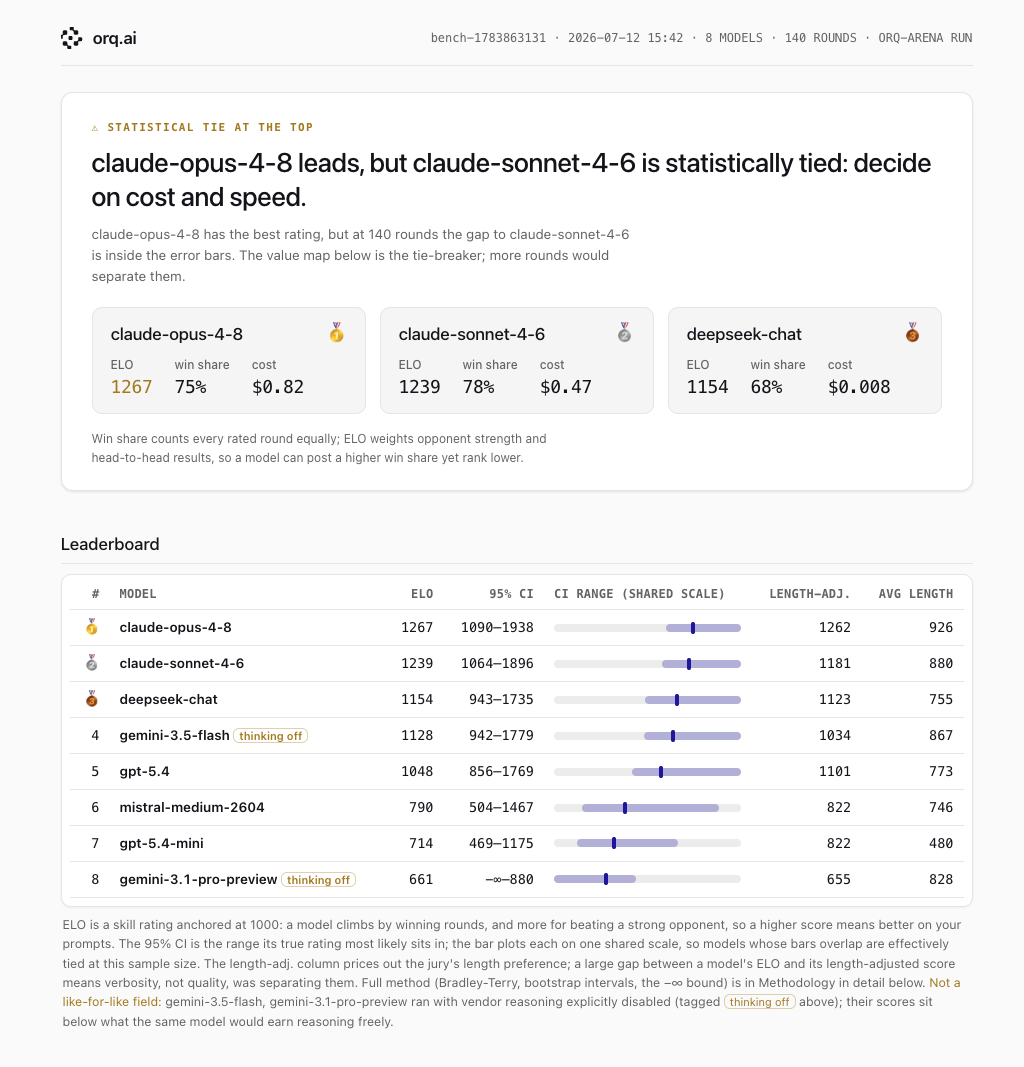
Pass --output path/to/file.jsonl to move all three; the manifest and report page always sit
next to the log. orq-arena report <log> regenerates the report page on demand, and
orq-arena rejudge re-scores a recorded run with a different jury at judge-token cost only
(see cli.md).
Troubleshooting
RuntimeError: ORQ_API_KEY is not set.
.env is missing, empty, or still the blank template. The message names the commands that
mint a key (orq auth login, then orq api-keys create --name orq-arena); you can
also create one per the API keys guide.
Fill it into .env (cp .env.example .env) and re-run. This only fires on run or
rejudge; report, annotate, anchor, and refresh-catalog all work with no key.
Error: the router rejected ORQ_API_KEY (401).
The key is set but not valid for the workspace you are calling. An orq API key is scoped to
one workspace, so a key minted elsewhere fails exactly this way. The preflight probe catches
it with one listing call before the run spends anything, which matters because otherwise
every judge call returns 401 and the run still produces a leaderboard-shaped result. Mint a
key for the right workspace with orq api-keys create --name orq-arena.
A response shows ✂ truncated in the live --tui show
The candidate hit its output cap (gateway.candidate_max_tokens, default 2048) before
finishing, and judges tend to penalize a cut-off answer. The marker is TUI-only; in a
headless run the same thing shows up as finish_reason_a/finish_reason_b of length
on that side in battles.jsonl. Raise gateway.candidate_max_tokens
in your YAML, or set a higher per-candidate max_tokens on that one entry. See
configuration.md.
A model you expected in the default pool isn't there
orq_arena.yaml deliberately excludes models the router can't disable thinking for.
Mixing an always-thinking model into the uniform thinking-OFF pool would compare
reasoning tokens no config could turn off. Add them to configs/reasoning_arena.yaml
(the thinking-ON preset) instead, or add them to your own YAML explicitly if a mixed
pool is what you want.
Next steps
| Goal | Where to go |
|---|---|
| See every subcommand and flag | cli.md |
Understand every orq_arena.yaml key |
configuration.md |
| Understand the scoring methodology | methodology.md |
| Contribute to the project | CONTRIBUTING.md |