Agent Design
The v1 solution combines a system prompt, policy-backed hosted code tools, and agent settings into one managed orq.ai agent.
The v1 system
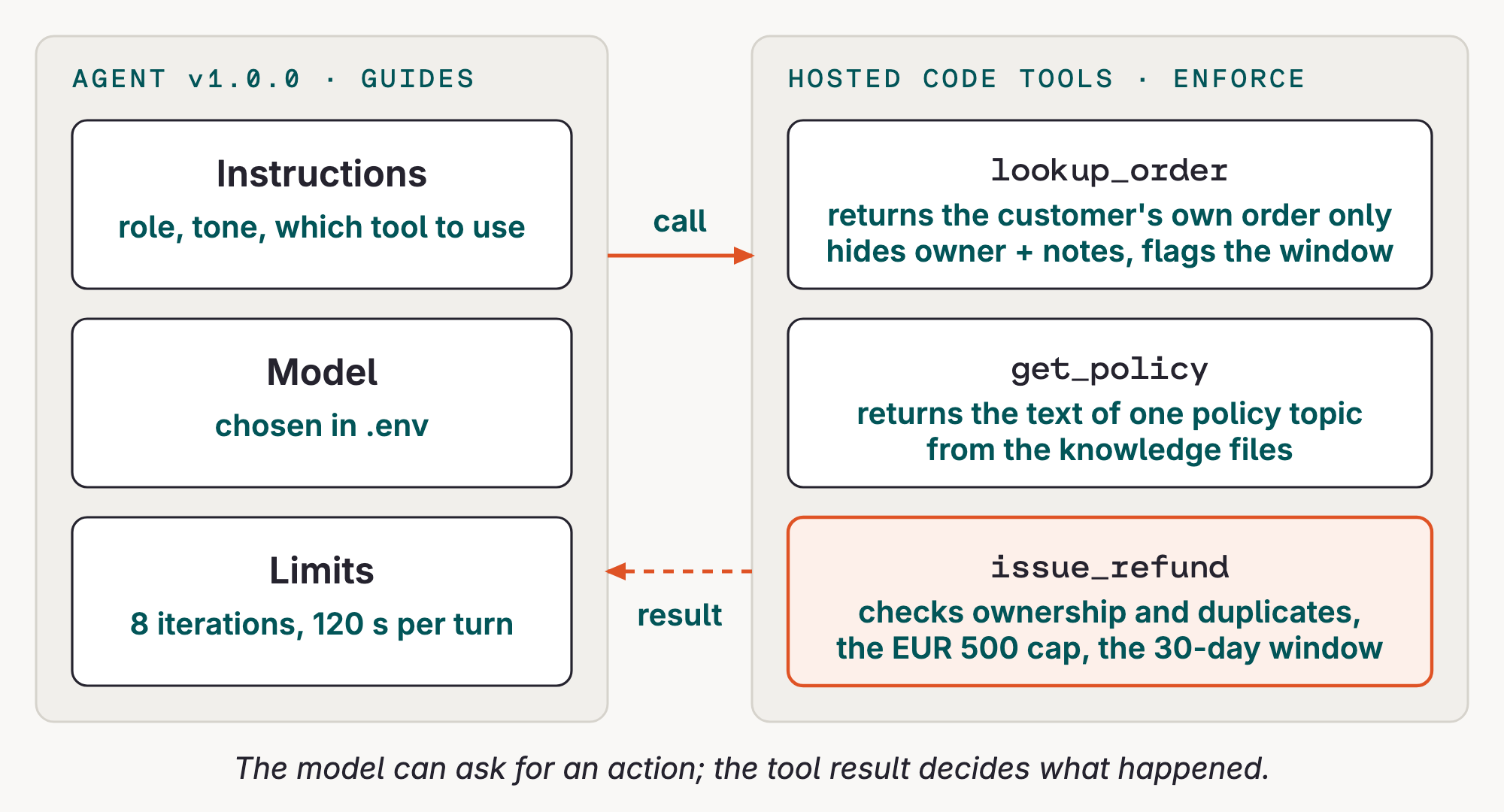
The prompt guides conversation and tool selection. Hosted code tools enforce the business rules. The model can request an action, but a structured tool result determines whether that action succeeded.
One refund decision
# 1. Check the order exists and belongs to this customer.
order = lookup_order(order_id)
if not order["ok"]:
    return explain("I cannot find that order")

# 2. Delivered more than 30 days ago? Read the exception policy
#    and check the reason and evidence before going further.
if not order["order"]["within_standard_window"]:
    policy = get_policy("post_window_exceptions")
    if not eligible_exception(customer_reason, evidence, policy):
        return route_to_human_review()

# 3. Issue the refund. The tool runs the final checks and says if it worked.
refund = issue_refund(order_id, reason, post_window_exception=exception)
return explain(refund)  # tell the customer what the tool returned
The model chooses what to say and which tool to call next. It does not calculate ownership, invent eligibility, or mark an order refunded itself.
Tool contracts and enforcement
The policy text lives in app/data/kb/. The tools in app/refund_agent/tools.py enforce mechanical checks: ownership, prior refund status, amount, delivery window and allowed exception reasons. The agent assesses the customer's reason and supporting evidence, then chooses whether to request a refund. The tool checks that request against its rules; it does not independently verify the evidence.
| Tool | What it does |
|---|---|
lookup_order |
Finds one of the customer's own orders. Any other order is not_found. |
get_policy |
Returns the text of one policy topic, such as refund_basics. |
issue_refund |
Refunds the order, but only if every check below passes. |
In a real storefront, issue_refund would move money. In this workshop it simulates that action using sample orders hosted with the tools on orq.ai; no payment is made, and each tool call starts from fresh fixtures. It runs its checks in order and stops at the first one that fails:
Source: issue_refund().
# issue_refund, simplified from app/refund_agent/tools.py
if not owned(order_id):
    return {"ok": False, "error": "not_found"}
if already_refunded(order_id):
    return {"ok": False, "error": "already_refunded"}
if amount(order_id) > 500:
    return {"ok": False, "error": "above_limit_needs_human_review"}
if outside_30_days(order_id) and not valid_exception(reason):
    return {"ok": False, "error": "outside_window"}
return {"ok": True, "amount_refunded": amount(order_id)}
The v1 instructions
app/data/instructions.md is the agent's prompt. The start of it:
You are the refund assistant for Lumen Goods.
Customers are already logged in to the storefront.

Tools:
- lookup_order: look up one of the customer's orders.
- get_policy: read the refund policy.
- issue_refund: refund an order.

How to work:
- Look up the order before you decide anything.
- Read the policy when you are not sure.
- Refunds are allowed within 30 days of delivery for any reason.
- Be warm and concise.
The prompt guides what the model chooses; the tools still decide what is allowed. You will see the full file, and change it, in Improve and Evaluate.
Next
Build the Agent creates and invokes this managed agent, then lets you inspect its tool calls and traces.
Official docs
- Create Tools: code-tool contracts and hosted execution
- Build Agents: instructions, tools, limits, and versions
- Run Agents: managed agent calls through the Responses API
- Traces: inspect model and tool execution